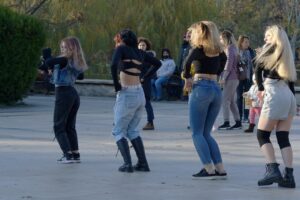

Learning dance online becomes easier when you choose lessons for their teaching quality—not simply because the routine looks enjoyable.
A complete beginner is learning several things at once: rhythm, coordination, weight transfer, direction, movement recall, and the vocabulary used by the instructor. A video that moves too quickly, hides the instructor’s feet, or demonstrates without explaining can make ordinary beginner difficulties feel like personal failure.
The better approach is to screen each class before committing to it, prepare the viewing setup, and use a repeatable feedback loop. The goal is not to copy an entire performance immediately. It is to identify a manageable section, understand what happens, practice it, check one observable detail, and decide what to do next.
Choose an Online Lesson You Can Actually Follow
Start by separating a dance performance from a dance lesson. A performance shows the finished choreography. A useful beginner lesson explains how to build it. It should give you enough information to answer practical questions such as:
- Which foot moves first?
- When does the weight transfer from one foot to the other?
- How many counts does the movement take?
- Is the instructor mirroring you or naming their actual right and left sides?
- Can you see the instructor’s full body and feet?
- Is the combination demonstrated slowly before music is added?
Labels such as “beginner,” “easy,” and “low impact” are useful starting points, but they do not define a consistent difficulty level. Hip-hop, salsa, K-pop, jazz, and dance fitness lessons can differ substantially in speed, impact, turns, coordination demands, floor work, and space requirements. Preview the opening, the first breakdown, and a later section before deciding whether the class suits you.
For a first lesson, favor foundations, introductory step breakdowns, or short combinations over a complete fast routine. Useful starting movements include marching to the beat, step-touch, step-touch variations, grapevine, a box step, simple hip isolations, and a small, controlled body roll.
You can also test whether the lesson matches your current foundations. March or tap along to an 8-count, then try a simple right-left-right-tap followed by left-right-left-tap. If the class immediately adds fast arms, turns, level changes, and travel before you can locate that basic rhythm, choose a slower breakdown first.
Match the lesson to your immediate goal
- To understand rhythm: Choose a lesson that counts aloud and lets you mark the beat before teaching choreography.
- To learn technique: Look for explanations of posture, foot placement, direction, and weight transfer.
- To remember choreography: Choose a short combination divided into named or counted sections.
- To stay active: Preview the intensity, impact, duration, and movement range rather than relying only on a “dance fitness” label.
- To learn a specific routine: Find a breakdown of that routine rather than repeatedly copying the finished performance.
Free tutorials on YouTube, structured courses such as STEEZY, and dance fitness apps can all provide usable instruction. The platform matters less than whether the individual class supplies an appropriate pace, visible demonstration, usable playback controls, and a clear learning sequence. Payment does not automatically make a lesson suitable.
A Beginner Rubric for Comparing Online Dance Lessons
Use the following rubric while previewing two or three possible lessons. Give each category a score of 0, 1, or 2. The total is a comparison tool, not a universal judgment about the instructor or platform.
| Criterion | 2: Beginner-friendly | 1: Usable with adjustments | 0: Likely poor match |
|---|---|---|---|
| Pace | The instructor pauses, counts, and teaches small sections before connecting them. | The explanation is somewhat fast, but pausing or reducing playback speed makes it understandable. | The routine is mainly shown at performance speed with little time to process each step. |
| Camera angle | The full body and feet remain visible, and the instructor clearly explains whether the view is mirrored. | Most movement is visible, but occasional cropping or direction changes require extra replaying. | Feet are regularly hidden, important movements happen off-screen, or the view makes direction difficult to determine. |
| Breakdown quality | Footwork, counts, weight changes, and transitions are explained separately before arms or styling are added. | The order is explained, but some details must be inferred from repeated viewing. | The instructor mainly says “follow along” or demonstrates without explaining how the movement works. |
| Music speed | The section is taught without music or with a slower track before the original tempo is used. | Only full-tempo music is provided, but the player allows useful speed control without making cues unusable. | The music is too fast to identify the steps, and there is no practical way to slow or isolate the section. |
| Progression | The class moves from foundations to short phrases and reviews earlier material before adding complexity. | The progression is uneven, but you can identify manageable sections to practice independently. | Difficulty rises abruptly or the class assumes steps, terminology, or coordination that were never introduced. |
A lesson scoring mostly 2s is a strong candidate for an initial practice. A lesson with several 1s may still work if you are comfortable pausing, slowing the video, or separating the footwork from the arms. Several 0s indicate that another lesson will probably provide a clearer starting point.
Pay particular attention to a zero for camera angle or breakdown quality. Playback controls cannot reveal feet that are never shown or supply explanations that were omitted. By contrast, a slightly fast but well-explained lesson may become usable when reduced to a slower playback speed.
If you are comparing paid classes, also check the stated level, prerequisites, lesson length, teaching format, space requirements, availability of modifications, access period, and cancellation terms. These details affect whether the course fits your circumstances even when the sample instruction looks clear.
Set Up the Screen, Space, and Playback Before You Start
A poor setup can make a suitable lesson unnecessarily difficult. Prepare the room and video before beginning so that you do not have to keep bending toward the screen, moving furniture, or searching for playback controls.
- Clear the movement area. Remove objects you could step on or collide with. Account for doors, low furniture, pets, other people, and any movement that travels forward, backward, or sideways.
- Check the surface. Use a stable area suitable for the style and wear secure footwear appropriate for the floor. Begin with compact steps until you know how much space the routine requires.
- Raise the screen. Position it where you can see the instructor without repeatedly bending or twisting your neck. A phone stand, monitor, television, or larger display can make foot placement easier to follow.
- Test the camera view. Confirm that the video shows the instructor’s feet as well as the upper body. If you plan to record yourself, frame your own feet and full movement area too.
- Find the controls. Locate pause, rewind, full-screen mode, captions if available, and playback speed before dancing. Choose a rewind point at the beginning of the section you intend to learn.
- Resolve connection problems. If the video repeatedly buffers, use an available download or offline option, or allow it to load before starting.
- Set safe audio. The beat and verbal cues should be audible without excessive volume. If using wireless earbuds, keep them secure and remain aware of people, pets, and activity around you.
Resolve right-and-left confusion first
Some instructors teach as though they are your mirror, so when they move to one side, you move to the same side on your screen. Others name and use their actual right and left sides. Watch the first repetitions without moving and listen for an explanation of the teaching orientation.
If no explanation is given, choose one consistent method for that lesson. Switching between mirroring the image and following verbal right-left cues halfway through a combination creates avoidable confusion.
Prepare your body for the lesson you selected
Use easy movement to transition into the session before attempting faster choreography. This might include comfortable marching, small side steps, gentle joint movements, and simple rhythm drills. Keep the chest comfortably lifted, shoulders relaxed, knees soft, and trunk supported without becoming rigid.
Preview any jumps, deep bends, fast turns, floor work, or large ranges of motion. You can often reduce the demand by marching instead of jumping, using smaller steps, limiting deep bends or arm range, and pausing fast turns. A modification is an alternative version, not a failure to complete the routine.
Use a Watch-Practice-Check Feedback Loop
The most useful feedback loop has three stages: watch for information, practice a small section, and check one observable detail. Repeat the loop instead of running the full video from beginning to end whenever something is unclear.
1. Watch
Select a two- or four-count section, or the shortest complete movement phrase offered by the instructor. Watch it once for the overall shape. Watch again to identify:
- the starting foot and body position;
- the count on which each step occurs;
- where the weight transfers;
- the direction of travel;
- whether arms, turns, or level changes can be temporarily removed.
Do not dance during this first stage. If you cannot explain the basic order after watching, rewind or choose a smaller section.
2. Practice
Mark the footwork with compact steps and no arm movements. Practice without music or at reduced playback speed. Once the order is clearer, add elements in layers:
- Foot placement
- Weight transfer
- Timing
- Direction changes
- Arms
- Styling or larger movement range
For example, a grapevine can first be practiced as side-behind-side-tap. After the feet and weight changes are consistent, add the arms. If adding the arms causes the footwork to disappear, remove them and rebuild that layer rather than restarting the entire routine.
3. Check
Pause the lesson and perform the section without following the screen. This tests recall rather than imitation. Then check only one detail:
- Did you start on the intended foot?
- Did the weight move fully enough for the other foot to step or tap?
- Did the turn begin on the stated count?
- Did you travel in the intended direction?
- Did you finish in the position needed for the next movement?
A mirror can help, but a short phone recording often provides a clearer review. Record about 20 seconds, then compare it with the instructor’s demonstration at reduced speed. Review one feature at a time, such as timing, foot placement, knee direction, torso position, or movement size. Trying to correct everything at once makes the feedback harder to apply.
Decide what the feedback means
After checking, make one of four choices:
- Continue: The order and weight changes are clear enough to add the next section.
- Repeat: You understand the movement but need another attempt to make the timing or transition more consistent.
- Simplify: Remove arms, turns, impact, or travel and practice the underlying step.
- Change lessons: The video does not provide the angle, explanation, or slower demonstration needed to understand the movement.
If live instruction, private feedback, or video review is available, ask a narrow question. “Which foot holds my weight before the turn?” or “Does the turn begin on count four or after count four?” is more actionable than asking how to “dance better.”
When Replaying the Same Lesson Helps More Than Finding a New One
Finding a new tutorial can feel productive, but repeatedly switching lessons may expose you to different terminology, camera orientations, and teaching methods before you have practiced any one sequence. Replay the same lesson when the instruction is understandable and the remaining difficulty comes from coordination, recall, or timing.
Replaying is especially useful when:
- you can describe the step but cannot yet perform it without the screen;
- the footwork works alone but breaks down when arms are added;
- you know each section separately but not the transitions;
- you always remember the opening but lose later sections;
- you can complete the movement slowly but not yet with the music;
- a short recording reveals one detail you can address on the next attempt.
Do not always restart from the beginning. Place the playback point just before the difficult section and work on that section directly. Otherwise, the opening may become familiar while the later choreography receives very little practice.
An illustrative practice structure
The following is an example rather than a target. Adjust the duration, intensity, and number of sections to your current ability and energy:
- 3–10 minutes: transition into activity with easy marching, comfortable joint movements, and rhythm drills.
- 10–25 minutes: use the watch-practice-check loop on one short combination.
- 5–10 minutes: review a recording or repeat the most difficult section more slowly.
- A few minutes: lower the pace gradually before finishing.
A complete beginner or someone returning after inactivity may prefer a much shorter session. Do not extend practice simply to finish the instructor’s video.
Keep a brief log containing the song name, tutorial link, section practiced, and one point to revisit. A note such as “review the left turn after count four” provides a clear starting point next time.
Signs that you are ready for the next lesson
Move on when you can perform the main section without constantly copying the screen, recover after a small memory lapse, and explain the basic timing and weight changes. The choreography does not need to look polished before you progress.
It can also be useful to stay with one style or set of foundations for several practices before adding substantially different movement patterns. Consistency gives you time to become familiar with recurring cues and steps.
Red Flags That a Lesson Is a Poor Match for You
A challenging lesson is not automatically a poor lesson. The important question is whether it gives you enough information and control to work through the challenge. The following signs suggest that a different class may be more useful:
- The level is unclear. The title says “beginner,” but the lesson assumes familiarity with terminology, turns, isolations, or named steps that are never explained.
- It is a demonstration rather than a breakdown. The finished routine is repeated, but the instructor does not isolate the footwork, counts, or transitions.
- Important movement is hidden. The feet are cropped, dark clothing blends into the background, or frequent camera changes make placement difficult to follow.
- Directional cues are inconsistent. The lesson switches between mirrored movement and the instructor’s actual right and left without clarification.
- The progression jumps abruptly. Arms, turns, travel, and speed are added at once before the underlying step is established.
- The music controls the teaching. The instructor repeatedly rushes to keep up with the song instead of giving enough time to understand the movement.
- There is no workable way to isolate a section. You cannot locate the beginning of the phrase, and the lesson does not recap or mark transitions clearly.
- The routine requires more space or equipment than you have. Continuing would mean moving around obstacles or using an unsuitable surface.
- Necessary modifications are absent. A class includes jumps, deep bends, fast turns, or floor work without enough time to choose a manageable alternative.
- Slowing the video does not solve the problem. If you still cannot identify the starting foot, count, or weight change, the missing issue may be the explanation rather than your effort.
Short social clips and edited performances can provide inspiration, but they may omit the teaching stages a beginner needs. Compare your practice with the lesson’s stated movement rather than with a polished finished performance. More useful signs of progress include clearer steps, steadier weight transfers, improved recall, and smoother transitions.
Exercise comfort, pain, and modifications
New activity can sometimes be followed by temporary muscle soreness or stiffness. Reduce the duration, pace, impact, or range of motion if a routine feels more demanding than expected. Do not use an online class to assess or treat pain or an injury.
Stop the session if you experience sharp, constant, or worsening pain; substantial swelling; a hot or red joint; pain that changes the way you walk; or other concerning symptoms. Seek guidance from an appropriate qualified healthcare professional if symptoms are severe, persistent, or difficult to interpret.
Stop exercising and obtain appropriate medical guidance for warning symptoms such as chest pressure, fainting, or significant dizziness. People with chronic conditions, disabilities, existing joint problems, rehabilitation needs, recent surgery, pregnancy, or recent changes in health may need individualized guidance before beginning or increasing dance activity, particularly for vigorous classes.
For arthritis or joint sensitivity, the suitability of a dance lesson depends on the style, intensity, surface, duration, and individual response. Begin gradually and adjust movements if symptoms increase. Marching instead of jumping, taking smaller steps, reducing arm range, limiting deep bends, and pausing fast turns are possible modifications, but individualized guidance may be appropriate when you are uncertain what suits a health concern.
Sources and safety references
- Physical Activity Guidelines for Americans — guidance on beginning with manageable amounts of activity and increasing gradually.
- CDC: Adding Physical Activity as an Adult — general considerations for increasing activity and seeking guidance when health concerns are present.
- CDC: About Physical Activity and Arthritis — general information about physical activity, joint symptoms, movement modifications, and seeking appropriate advice.
The DanceFit Studio Editorial Team publishes practical, beginner-friendly content about dance fitness, home workouts, dance learning, equipment, and safer practice habits. Our guides are prepared for general educational purposes, with a focus on clear instructions, realistic routines, and accessible information for different experience levels. The content does not provide medical diagnosis or personalized treatment advice.