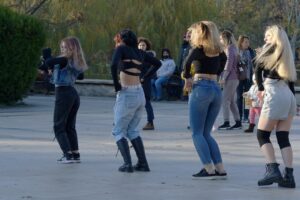

Learning a basic dance move is better measured by what you can do than by how many days have passed. Recognizing a step, performing it slowly, staying with music, recovering from an error, and using it consistently are separate achievements.
Instead of asking when a move “should” be finished, identify the next observable skill. You might need to remember the order, complete the weight transfer, find the beat, connect two steps, or continue without watching an instructor. Each result points to a specific practice task.
There Is No Single Clock for Learning a Dance Move
The word “basic” describes a move’s role in a dance style, not a universal learning schedule. A step-touch may have a short sequence, yet it can involve rhythm, complete weight transfer, posture, direction, and coordinated arm movements. A box step adds a spatial pattern. A beginner salsa basic adds a particular rhythm and may eventually include partner connection.
The intended setting changes the task as well. Someone preparing for a casual party may mainly want to find the beat and keep moving after a missed step. A wedding routine requires agreed cues and dependable transitions. Dance fitness involves recognizing recurring patterns while choosing an appropriate level of effort. Performance choreography may require more precise timing, spacing, and presentation.
Progress is influenced by several interacting factors:
- the number of actions contained in the movement;
- whether the rhythm is even, syncopated, paused, or unusually fast;
- previous experience with dance, music, sport, or theatre;
- current balance, coordination, mobility, and movement familiarity;
- how clearly the movement has been demonstrated or explained;
- whether practice includes active recall rather than continuous copying;
- whether the move is performed alone, with a partner, or in a group;
- the amount of travel, turning, or directional change involved; and
- the standard required for the learner’s particular goal.
Two people can therefore work on the same named step and face different problems. One may understand the pattern but struggle to hear the count. Another may stay on time but use incomplete weight transfers. A third may perform comfortably alone but lose the sequence around other dancers.
These differences make calendar comparisons unreliable. A clearer question is: Which part of the skill is dependable now, and under what conditions?
Use Skill Milestones Instead of Week Counts
A useful milestone describes an ability that can be observed and retested. The following stages separate several meanings that are often compressed into the phrase “I know this move.”
| Milestone | What it looks like | How to check it | What to practice next |
|---|---|---|---|
| Recognizing the move | You can identify its starting position, direction, rhythm, and general pattern when it is demonstrated. | Pause before the next action and describe which foot moves, where it goes, and on which count. | Reproduce a small section from memory rather than copying continuously. |
| Doing it slowly | You can complete the correct order at a manageable pace without relying on every instructor cue. | Perform the move while counting aloud, then repeat while looking forward instead of at your feet. | Clarify weight transfer, posture, step size, direction, and the most uncertain count. |
| Doing it to music | You can begin on an intended count and maintain the pattern through a suitable musical phrase. | Use more than one suitable song so success is not tied to a single memorized recording. | Reduce hesitation, refine timing, or connect the movement to a neighboring step. |
| Recovering from mistakes | You can pause, simplify, or miss a step and then rejoin on a clear beat or phrase. | Deliberately stop during a short sequence and attempt to return without restarting from the beginning. | Practice recognizing musical landmarks and safe, simple ways to keep moving while resetting. |
| Using it consistently | You can recall and perform the move repeatedly under the conditions relevant to your goal. | Use it in a sequence, class, social setting, or partner practice with fewer prompts and manageable variation. | Develop transitions, adaptability, expression, spatial control, or performance detail. |
These stages are not always completed in a neat line. A move may work with one familiar song but disappear with another. Footwork may be dependable until arms or travel are added. A learner may complete the move correctly but still restart the entire routine after one missed count.
That does not erase earlier progress. It identifies the condition that is not yet reliable. The next practice task should address that condition rather than repeating everything indiscriminately.
What Makes One Move Take Longer Than Another
A move’s visible shape does not reveal every task involved in performing it. Several hidden demands can determine how readily it becomes repeatable.
Movement layers
Foot placement, weight transfer, rhythm, direction, posture, arms, head position, and expression are separate layers. A learner may put each foot in the correct place without shifting enough weight to release the other foot. Adding arms before the lower-body pattern is stable can make both layers less consistent.
When a movement feels overloaded, remove one layer. Practice the feet without the arms, the rhythm without travel, or the direction change without the preceding combination. Add the removed detail again only after the core pattern is clear.
Rhythm and tempo
Even counts usually create a different learning problem from syncopation, pauses, or rapid changes of direction. If the move disappears when music starts, separate listening from moving. Clap the beat, speak the counts, or mark the rhythm with small weight shifts before restoring the complete step.
A manageable tempo can expose the exact count where hesitation begins. Merely repeating at a pace that prevents control may hide the underlying problem.
Transitions
A move that works in isolation may fail when placed inside a routine. The ending position of one movement must support the start of the next. Direction, free foot, weight placement, and timing all affect that connection.
Practice the final counts of the first move and the opening counts of the second as a short loop. This gives the transition more attention than restarting the full routine after every error.
Travel, turns, and use of space
Traveling patterns require awareness of direction and available space. Turns may add balance, spotting, orientation, and a complete weight shift. Oversized steps can make it difficult to arrive in time for the next action.
Temporarily making a pattern smaller can clarify its structure. Travel can then be increased gradually when the timing and direction remain manageable.
Partner and environmental demands
Partner dancing adds shared timing, connection, leading or following, and adjustment to another person. A move that is familiar alone may require new attention when practiced with a partner.
Classes and social settings also add distractions, unfamiliar music, limited space, and other moving people. Dependability in a quiet room does not automatically transfer to those conditions.
Type of instruction and feedback
Online lessons, including material on YouTube or STEEZY Studio, can be paused and repeated privately. However, a prerecorded lesson cannot automatically identify whether a problem comes from timing, weight transfer, direction, or another detail.
Group beginner classes provide structure, practice around other dancers, and potential instructor feedback, although the class pace may not suit every participant. Private instruction can focus on a particular objective or recurring coordination problem. Targeted private dance lessons may help clarify which component needs attention. Teaching style, availability, and cost vary, and instruction still needs to be paired with suitable practice.
A Progress Log for One Dance Skill
A useful log records evidence rather than only minutes practiced. Choose one narrow skill, such as a step-touch, grapevine, box step, introductory turn, body roll, or short eight-count. Keep the definition stable long enough to compare attempts.
1. Define the version
Write down the starting foot, direction, rhythm, and stopping point. “Practice salsa” is too broad to evaluate. “Complete the basic foot pattern while maintaining the count” gives you something specific to observe.
2. State the current milestone
Record whether you can recognize the movement, perform it slowly, use it with music, recover after an error, or perform it consistently. Do not move it to the next stage because one attempt happened to work. Look for repeatability under the relevant conditions.
3. Choose one feature to inspect
- Foot placement: Does each foot arrive in the intended position?
- Weight transfer: Does your weight move enough to free the next foot?
- Timing: Do you begin and finish on the intended counts?
- Step size: Are large movements making you late or unstable?
- Direction: Do you finish facing the intended way?
- Recall: Can you continue after the demonstration stops?
- Recovery: Can you rejoin without returning to the beginning?
4. Match the drill to the problem
- For unclear footwork: Repeat a small section at a manageable pace and gradually shift your gaze away from the floor.
- For lost timing: Clap or count “1-2-3-4” before adding the feet. A metronome app or suitable song on YouTube can provide a steady reference.
- For incomplete weight transfer: Practice shifting from one foot to the other before adding travel, turns, or arms.
- For overloaded coordination: Remove the arms, reduce the travel, or mark the turn before rebuilding the full movement.
- For dependence on one recording: Test the same step with different suitable songs.
- For a weak transition: Loop the final part of one move and the opening part of the next.
- For poor recovery: Deliberately pause, keep a simple pulse, and rejoin at the next recognizable count or phrase.
5. Capture concise evidence
A mirror provides immediate visual information, while a short phone recording can be reviewed after the attempt. Compare one feature at a time with the demonstration. Reviewing order, timing, posture, and expression simultaneously can make it difficult to choose a useful correction.
A compact log can contain:
- Move: the exact step, turn, or transition;
- Current milestone: recognized, slow, with music, recovery, or consistent;
- Test condition: counts, chosen song, short sequence, partner, or class setting;
- Observable success: what remained correct or controlled;
- Breakdown point: the count, transition, or condition where control changed;
- Next adjustment: one cue, drill, or simplification; and
- Retest: the same check to repeat during the next suitable practice.
Begin practice by gradually increasing movement with easy marching, gentle step-touches, or controlled motions relevant to the planned session. Keep the warm-up appropriate to the activity rather than turning it into a demanding routine. Choose a manageable practice demand, increase complexity gradually when appropriate, and use easier activity or rest when fatigue begins to affect movement quality.
What a Plateau Can Tell You
A plateau can indicate that the current drill no longer matches the problem. More repetitions are not always the most informative response. Note where the move changes, then select a smaller test.
- You can copy but not recall: Pause the demonstration and reproduce a shorter section from memory.
- You remember the order but lose the beat: Remove the arms, clap the rhythm, and use smaller steps or a more manageable tempo.
- You are on time until a turn: Isolate the turn and inspect its entry step, weight transfer, and finishing direction.
- You can dance to only one song: Use another suitable track to test whether the movement is independent of one recording.
- You can perform the move alone but not in sequence: Practice only the transition into and out of it.
- You restart after every error: Practice keeping a simple pulse and returning on the next clear musical landmark.
- You can do it at home but freeze around others: Introduce the intended environment gradually through a beginner class, workshop, or low-pressure practice with a friend.
- Attempts become less controlled: Fatigue may be affecting practice quality; reduce the demand and reassess rather than automatically adding more work.
Frequently switching among unrelated tutorials can also make progress difficult to detect. Each new movement introduces different timing, terminology, and coordination demands. Concentrating on one style and a small set of connected fundamentals makes changes easier to observe. Platforms such as Steezy or online dance classes can be useful when they allow a relevant section to be repeated at an appropriate pace.
Keep practice physically manageable
Movement unfamiliarity and ordinary effort are not the same as pain. Do not continue through sharp pain, joint pain, dizziness, chest discomfort, or feeling unwell. Stop the activity and reassess before returning to it.
People with arthritis, joint concerns, disabilities, significant medical conditions, injuries, rehabilitation needs, recent surgery, unexplained symptoms, or a return following physiotherapy may need individual modifications. Seek guidance from an appropriate qualified healthcare professional when personal advice about suitable movement or intensity is needed. Individualized guidance may also be appropriate during pregnancy.
As general emergency guidance, stop dancing and seek immediate medical attention for chest pressure or persistent chest pain, particularly when accompanied by sweating, nausea, dizziness, or shortness of breath.
Decide What ‘Learned’ Means for Your Goal
A move does not switch instantly from “unlearned” to “learned.” The appropriate completion standard depends on where and how you intend to use it.
- Following a beginner class: You can recognize the movement, reproduce its main pattern, and rejoin after missing a repetition.
- Casual social dancing: You can maintain a comfortable rhythm, adapt to the available space, and continue after small mistakes.
- Partner dancing: You can maintain your own timing and balance while responding appropriately to the connection.
- A wedding routine: Both partners can recall the agreed sequence, recognize transition cues, and recover if someone loses their place.
- Dance fitness: You can recognize recurring patterns and follow them at an intensity appropriate for you without requiring every detail to match the demonstration.
- A performance: You can reproduce the choreography under the relevant musical, spatial, and presentation conditions. This is a higher standard than recognition or basic participation.
Once the standard is clear, replace “How long should this take?” with three practical questions:
- What can I demonstrate now?
- Under which conditions does it remain dependable?
- Which missing ability should the next drill address?
If you recognize the move but cannot perform it slowly, work on sequence and weight transfer. If you can perform it slowly but lose it with music, isolate the rhythm. If it works with music but disappears after an error, practice recovery. If recovery works but the movement remains unreliable in its intended setting, add relevant transitions, songs, partner cues, space, or distractions gradually.
The useful measure of progress is the change in what you can reliably do. A move can be considered learned for one goal while still leaving room for greater consistency, adaptability, musicality, or performance detail.
Sources and Safety References
- NHS: How to warm up before exercising
- CDC: Adding physical activity as an adult
- MedlinePlus: Are you getting too much exercise?
- CDC: Physical activity and arthritis
- CDC: Physical activity for people with chronic conditions or disabilities

The DanceFit Studio Editorial Team publishes practical, beginner-friendly content about dance fitness, home workouts, dance learning, equipment, and safer practice habits. Our guides are prepared for general educational purposes, with a focus on clear instructions, realistic routines, and accessible information for different experience levels. The content does not provide medical diagnosis or personalized treatment advice.