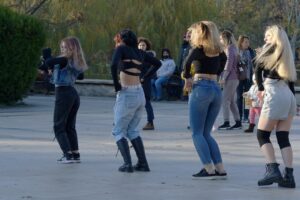
The best beginner dance style is not the same for every person—or every home.
A style that feels approachable in a large room may be frustrating in a narrow bedroom. Fast choreography can energize one beginner while making another feel rushed. Some people want social-dance skills; others want expressive movement, repeated grooves, or an active workout set to familiar music.
Use this guide to match dance styles to four practical factors: available space, tempo complexity, suitability for solo practice, and the way lessons are taught. You do not need a studio, mirror wall, partner, or “natural rhythm” to begin, but you do need a style and lesson format that fit your circumstances.
Start With the Kind of Experience You Want
Before choosing a dance label, decide what you want the practice itself to feel like. The answer can narrow your options more effectively than searching for the style described as “easiest.”
- You want repeated, grounded movement: Beginner hip-hop grooves may suit you. Introductory lessons often focus on rhythm, footwork, weight shifts, and body control before combining them into choreography.
- You want skills that connect to social dancing: Solo salsa practice introduces timing, weight transfer, basic steps, side steps, and simple turns without requiring a partner.
- You enjoy learning a sequence through repetition: Compact line dances can make the structure of a routine easy to recognize, although some combinations travel more than expected.
- You want continuous, energetic movement: Beginner dance-fitness, modified Zumba-style, or Afrobeats fitness classes may fit. Look beyond the style name and check the actual pace, jumping, bends, and direction changes.
- You prefer expression, control, or slower music: Standing contemporary combinations, ballet basics, or barre-inspired dance may be appealing. Floorwork, large traveling phrases, deep stretches, and advanced positions are not necessary starting points.
- You want to learn recognizable choreography: A beginner K-pop or short-form choreography tutorial may provide a clear goal. Choose a broken-down or modified version rather than one taught only at performance speed.
Your goal can also affect the choice. Solo salsa or party-dance grooves may be directly relevant to social confidence. Contemporary or ballet-inspired practice may place more attention on movement quality and control. Dance-cardio formats can contribute to an active routine, although body-weight changes depend on food intake and individual factors as well as activity.
Beginner Dance-Style Comparison Matrix
This matrix describes common beginner lesson formats, not every class carrying a particular label. An introductory hip-hop lesson can be slow and compact, while another may include quick choreography and jumps. Preview the specific class before deciding whether it fits.
| Style | Typical space needs | Tempo complexity | Solo suitability | Useful learning format |
|---|---|---|---|---|
| Hip-hop basics | Low to moderate when lessons emphasize stationary grooves; more space may be needed for traveling choreography. | Variable. Repeated grooves can be approachable, while layered footwork and fast combinations add complexity. | High | Step breakdowns, groove drills, mirrored instruction, and reduced-speed choreography. |
| Solo salsa | Low for stationary basics; moderate for turns and traveling patterns. | Moderate because the dancer must connect foot placement, weight transfer, and musical counts. | High for foundational steps; partner skills eventually require another person. | Counted demonstrations, footwork drills, and lessons that separate steps from turns. |
| Line dancing | Low to moderate. Check for forward, backward, and sideways travel. | Low to moderate in beginner routines, with complexity increasing as sequences become longer. | High | Repeated walkthroughs, counted sections, and practice facing the same direction as the instructor. |
| Dance fitness or Zumba-style classes | Moderate, although low-travel classes can work in smaller rooms. | Often moderate to high because movement continues while combinations change. | High | Follow-along classes with visible low-impact, no-jumping, or reduced-range options. |
| Beginner contemporary | Moderate to high for traveling phrases or floorwork; lower for standing combinations. | Variable. Slower music does not always mean simpler coordination. | High | Technique explanations and short standing phrases taught in sections. |
| Ballet basics or barre-inspired dance | Low for stationary exercises, provided any support used is stable and suitable. | Often slower, but precise placement, balance, and terminology can make it mentally demanding. | High for basic standing work | Clearly cued beginner instruction that does not assume prior terminology or force positions. |
| K-pop or short-form choreography | Moderate; modified tutorials may reduce travel and jumping. | Often high because gestures, footwork, direction changes, and musical details may be layered together. | High | Section-by-section tutorials with mirrored views and playback-speed controls. |
| Afrobeats fitness | Moderate, depending on travel and movement size. | Moderate to high in continuous follow-along classes. | High | Beginner dance-fitness instruction with previews, repeated combinations, and modification options. |
“Low tempo” and “easy” are not interchangeable. A slow contemporary or ballet-inspired exercise may require detailed balance and placement. A faster line dance may feel simpler if it uses a short sequence that repeats predictably. The better indicator is how many new tasks the lesson asks you to coordinate at once.
Match a Style to Your Space and Music Preferences
Start with the room rather than the trend. The goal is not merely to fit your body into the space while standing still; you need clearance for the steps, arm movements, and turns used in the lesson.
For a practical check, stand in the center of the intended practice area and slowly step forward, backward, and to both sides. Raise your arms and test any planned turn at reduced speed. Confirm that you can move without contacting furniture, walls, ceiling fixtures, cables, pets, or other people. The room should have a clear, stable, nonslip surface appropriate for the movement.
A loose rug or unsecured exercise mat can shift or catch the feet during standing turns and side-to-side steps. Footwear requirements vary by dance form and floor. Properly fitting shoes may be useful for dance-fitness practice, but footwear that grips excessively during a turn or slides unpredictably can make movement harder to control.
For more detail on setting up the room, use this guide to creating a small dance practice space at home.
If your room is narrow or crowded
Look for stationary salsa basics, compact line dances, beginner hip-hop grooves, barre-inspired standing combinations, or K-pop tutorials specifically modified to limit travel and jumping. Avoid relying on the video thumbnail or dance label; scan the lesson to see how far the instructor moves in every direction.
If you have more open floor area
You may have more flexibility to try contemporary phrases, larger dance-fitness combinations, turns, or choreography that travels. More room does not remove the need to learn direction changes slowly and maintain control.
Use music preference as a practical filter
A technically suitable style can still be a poor match if you dislike its music. Notice which listening experience makes you curious to move:
- Strong beats and repeated grooves: Try hip-hop basics or party-dance combinations.
- Latin rhythm and counted footwork: Try solo salsa or a beginner Latin dance-fitness class.
- Pop songs and recognizable routines: Try beginner K-pop or short-form choreography.
- Continuous upbeat tracks: Try modified dance fitness, Zumba-style, or Afrobeats fitness.
- Slower, atmospheric, or expressive music: Try a standing beginner contemporary lesson.
- Structured instrumental music and precise exercises: Try ballet basics or barre-inspired dance.
You do not have to stay within one musical category. Music is simply a useful predictor of whether you will be willing to replay the lesson after the novelty wears off.
What Makes a Style Feel Easier or Harder at Home
Difficulty comes from the interaction between the routine, teaching method, environment, and your current familiarity with the movements. The style name alone cannot tell you how manageable a lesson will be.
Tempo and the number of simultaneous tasks
A routine becomes harder when it combines quick feet, arm patterns, turns, level changes, and musical accents before each element is familiar. Practice the feet first, add the arms later, or learn without music before returning to the original track. On YouTube, playback controls can help you study a few counts at reduced speed.
Travel, turns, and impact
Large traveling steps require more room and spatial awareness. Turns add balance and orientation demands. Jumps increase impact and may not suit the person, floor, or setting. Search within your chosen style for lessons described as “beginner,” “low impact,” or “no jumping,” and preview the movements before following at full speed.
For salsa or other turning styles, begin with basic steps and weight transfers before adding rotations. Reduce or omit turns if they cause dizziness, pain, or instability. Smaller steps, shallower bends, slower turns, and reduced arm ranges are valid modifications; your movement does not need to match the instructor’s size or speed.
The way the class is taught
A class may feel accessible when the instructor demonstrates from a useful camera angle, names or counts the steps, repeats each section, and shows modifications. It may feel unnecessarily difficult when choreography is presented at performance speed with little explanation.
Free tutorials on YouTube, fitness apps, structured online dance classes, and in-person lessons each offer different levels of sequencing and feedback. A structured course can be easier to follow than unrelated videos when later lessons build on previously introduced steps. This comparison of STEEZY and other lesson formats can help you consider those differences.
Your control matters more than visual similarity
A mirror or phone recording can show whether you stay within the available space, rush the beat, or lose track of direction. It cannot provide an individualized movement assessment. When reviewing a recording, look for observable details: controlled foot placement, manageable direction changes, enough clearance, and the ability to continue without repeatedly scrambling to catch up.
Begin at a lower pace and intensity so breathing and heart rate rise gradually, then finish by reducing the pace rather than stopping immediately after the most demanding section. Do not force stretches, deep bends, or dance positions.
If movement causes pain, feels unstable, or repeatedly creates uncomfortable joint positioning, stop or modify it. Some temporary stiffness or soreness can occur after unfamiliar activity, but sharp or constant pain, substantial swelling, pain that causes a limp, severe symptoms, or symptoms that do not improve warrant medical advice. Chest pressure or pain—especially with shortness of breath, sweating, nausea, or dizziness—requires prompt medical attention.
Arthritis or another chronic condition does not automatically rule out dancing, but the class and movements should be tolerable and appropriate for the individual. Qualified healthcare guidance is appropriate when symptoms are severe, persistent, changing, or affected by a significant medical condition, recent surgery, injury, or rehabilitation.
Try a Style Without Committing to It
Before buying a subscription, equipment, or specialized footwear, run a low-commitment comparison using sample lessons. The purpose is not to master each style. It is to find out which one fits your room, music preferences, attention, and preferred way of learning.
- Select two or three contrasting styles. For example, compare hip-hop grooves, solo salsa, and standing contemporary rather than testing three similar dance-cardio classes.
- Choose true introductory samples. Look for a basic-step lesson or short beginner combination, not a highlight reel or advanced routine.
- Preview before moving. Check for travel, jumps, turns, floorwork, deep bends, camera changes, and any objects the instructor uses.
- Test the lesson at reduced speed. Practice one basic step or section. Pause and repeat as needed instead of treating completion as the goal.
- Use the same decision questions after each sample. This makes the comparison about fit rather than about which choreography looked most impressive.
An illustrative trial might be five or ten minutes of basic steps, or part of a 20-minute beginner video after work. These are examples, not required session lengths. Stop when you have enough information to judge the style or when your movement quality begins to decline.
After each sample, answer:
- Could I perform the basic version without hitting anything or constantly relocating?
- Did the music make me want to continue?
- Could I understand the instructor’s counts, cues, and camera orientation?
- Was the routine challenging because it was new, or unsuitable because it demanded too much speed, space, impact, or range?
- Could I identify one step I would be willing to repeat?
- Did the class provide useful beginner options rather than expecting me to copy the full version?
If a style appeals to you but the sample does not, test a different beginner teacher or learning format before rejecting the style. Conversely, a well-produced video cannot make a style fit if you dislike the music or cannot safely accommodate its movement in your room.
Choose the Style That Makes You Want to Practice Again
There is no objectively easiest dance style for every beginner. Hip-hop grooves may feel natural to someone who connects with the beat but confusing to someone who prefers counted sequences. Line dancing may feel reassuring because it repeats, yet difficult for someone who dislikes memorizing patterns. Contemporary music may be slower, but its balance and movement detail can still be demanding.
Your strongest match is the style that meets enough of these conditions:
- It fits the space and floor you actually have.
- Its beginner tempo allows you to move with control.
- It works for solo practice, or clearly supports any later partner-dance goal.
- The lesson format explains movements in a way you understand.
- The music holds your attention.
- The routine can be modified without losing the part you enjoy.
- You finish curious about repeating a step rather than relieved that the video is over.
Staying with one style for several sessions can make recurring steps and terminology more recognizable, but no fixed timeline is necessary. Duration, movement range, speed, and complexity can increase gradually according to how you respond.
If two styles score equally well, keep both. One might suit compact practice on a busy day, while another works when you have more room and energy. A useful home dance choice does not need to become a permanent identity; it only needs to make the next practice session feel worth starting.
Sources and safety references
- Physical Activity Guidelines for Americans — guidance on choosing appropriate activity and increasing duration and intensity gradually.
- CDC: About Physical Activity and Arthritis — information on gradual activity, joint-friendly options, and symptoms that warrant medical advice.
- CDC: Pain During or After Exercise — general guidance on discomfort and warning signs during physical activity.
- CDC: Physical Activity and Your Weight and Health — context on physical activity and weight management.

The DanceFit Studio Editorial Team publishes practical, beginner-friendly content about dance fitness, home workouts, dance learning, equipment, and safer practice habits. Our guides are prepared for general educational purposes, with a focus on clear instructions, realistic routines, and accessible information for different experience levels. The content does not provide medical diagnosis or personalized treatment advice.